University College Cork
Parkinson's symptoms across women's hormonal life stages
A University College Cork study of how Parkinson's symptoms differ between women who are still menstruating and women past the menopause, using online surveys and daily tracking in the My Moves Matter app.
Why this research matters
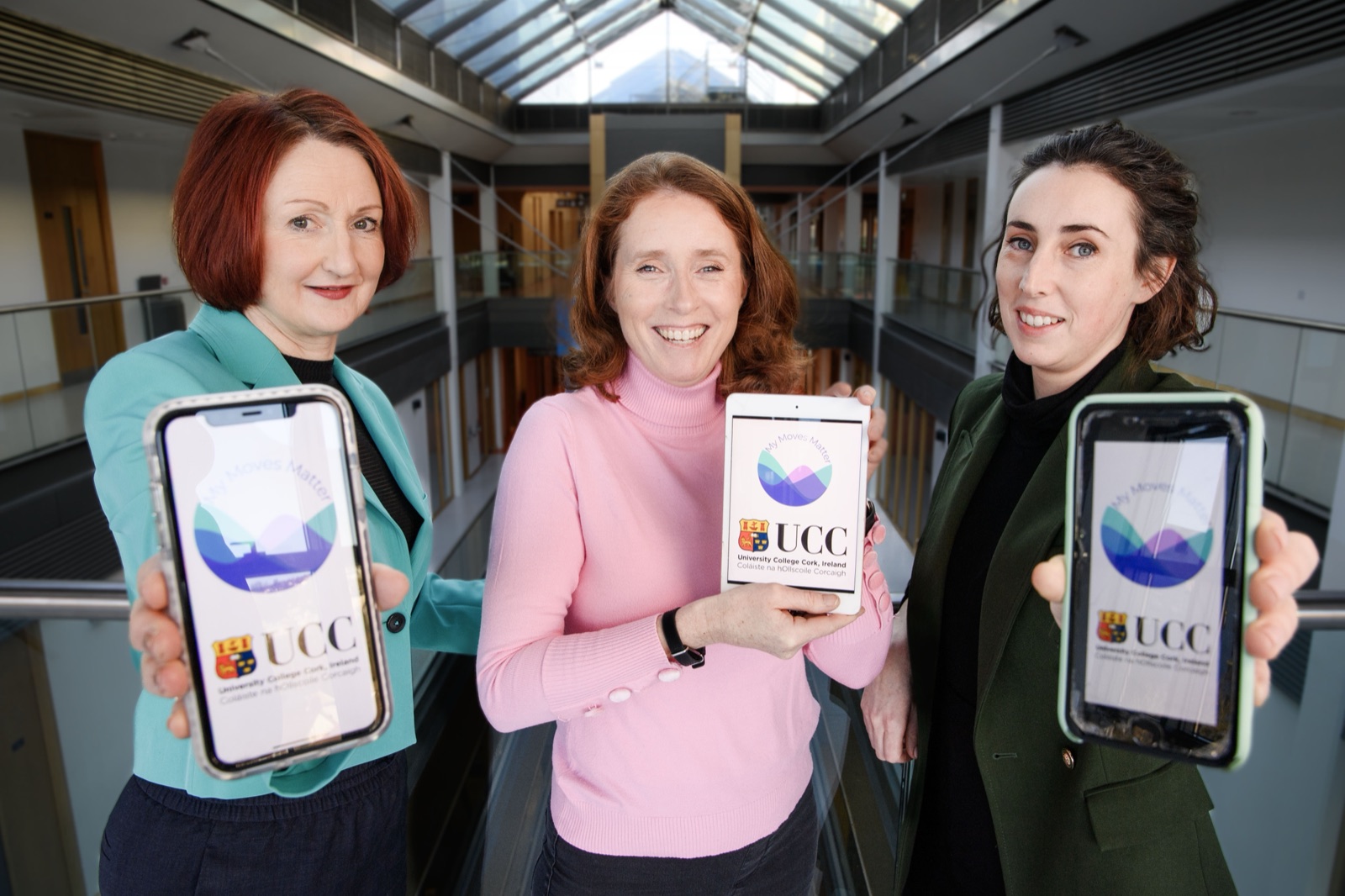
Women have been under-represented in Parkinson's research, and the influence of hormonal changes on symptoms has rarely been studied. Many women with Parkinson's describe symptoms that shift around their menstrual cycle or through the menopause transition, yet these experiences have been poorly recorded and poorly understood. My Moves Matter grew out of exactly this gap: the tracking app was first built so that women could record symptoms, medication and periods day by day and see their own patterns.
Research questions
- Do the types of symptoms women report differ between those who are still menstruating and those who are past the menopause?
- Do symptoms and medication effects vary across the menstrual cycle when tracked daily?
- What can patient-reported, longitudinal data add to clinic-based assessments?
Design and methods
The study combined two sources of information. Women with Parkinson's aged 18 and over, anywhere in the world, completed online surveys about their demographics, symptoms and medication. A subgroup then tracked symptoms, medication and menstrual cycles daily in the My Moves Matter app for about four months, followed by final surveys. Only medication, symptom and period data were shared with the research team, in anonymised form. The study was led by University College Cork; My Moves Matter provided the concept, the app and the survey platform and is a co-author on the outputs.
Participants and status
493 women with Parkinson's completed the online surveys, and 131 of them also tracked in the app. Data collection has ended. Early findings were presented as two posters at the World Parkinson Congress in May 2026, and a paper has been submitted for peer review. Recruitment is closed.
What the early findings show
In the survey data, the overall number of symptoms reported was similar in both groups, but the types differed. Women who were still menstruating more often reported stiffness and slowness, pain, anxiety, low mood and mood swings. Women past the menopause more often reported balance difficulties, loss of smell and constipation. In the smaller group who tracked in the app, several symptoms also differed by menstrual status. A sub-analysis of hormone-replacement therapy involved very small groups, and the research team has been explicit that no firm conclusion can be drawn from it.
How to read these results
These are preliminary, conference-presented findings from self-reported data. They describe associations between menstrual status and reported symptoms; they do not show that hormonal changes cause particular symptoms, and they are not clinical outcome measures. The peer-reviewed paper, once published, is the authoritative account and this page will be updated to reflect it.
The app used in this study
Participants tracked in the My Moves Matter App, our established mobile app for everyday tracking (English and French). It is a separate product from My Moves Matter Connect, the platform's newer connected tracking experience. About the app and how to get it.
Publications and presentations
- Tracking symptoms and medications in women with Parkinson's disease (poster P39.21)
Moore S, Collins Stack L, Flanagan R, Reinbacher R, Lavelle A, Sullivan AM · Abstracts of the 7th World Parkinson Congress, Journal of Parkinson's Disease 16(S1), 2026 · 2026 · poster
- Non-motor symptomology in women with Parkinson's disease (poster P27.07.B)
Toomey E, Moore S, Collins Stack L, O'Shea E, Lavelle A, Flanagan R, Reinbacher R, Sullivan AM, O'Keeffe F · Abstracts of the 7th World Parkinson Congress, Journal of Parkinson's Disease 16(S1), 2026 · 2026 · poster
Facts on this page last reviewed 2026-10-24.